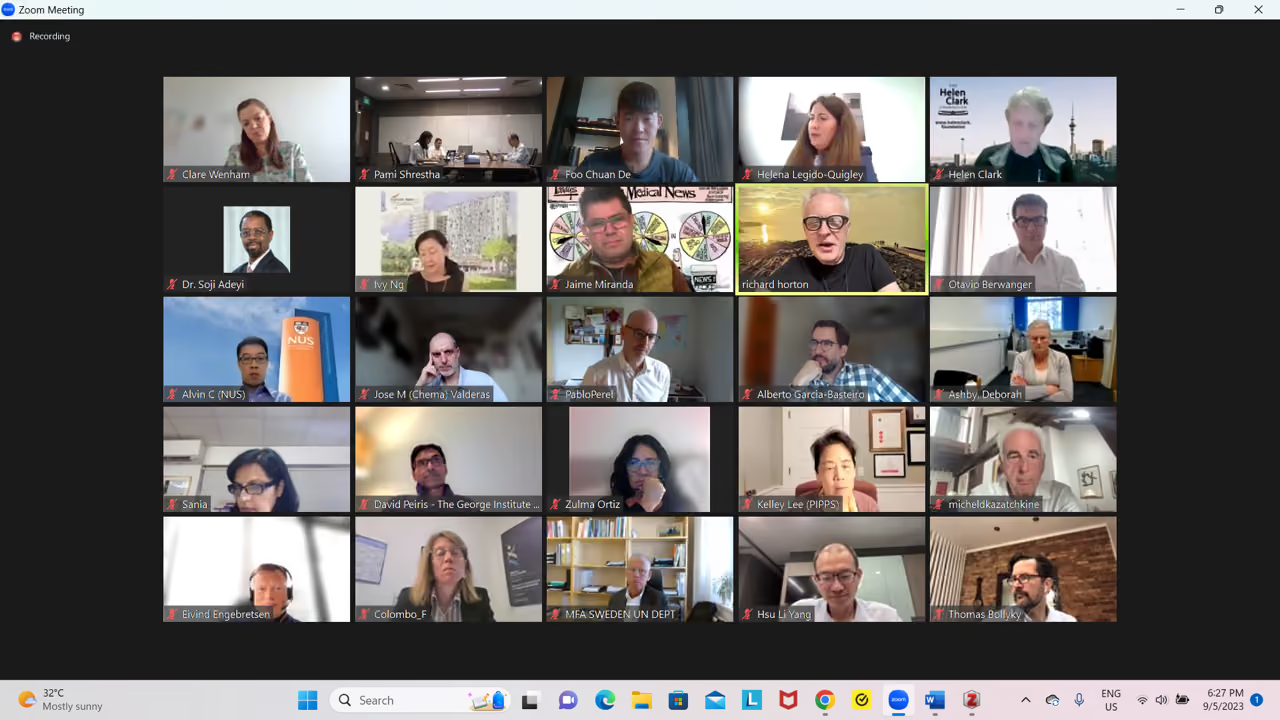
Online meeting of The NUS-Lancet PRIME Commission, 9th May 2023
The first meeting of the NUS-Lancet PRIME Commission was held virtually on 9 May 2023. The Commission aims to develop a new, independent and comprehensive approach to assessing how prepared countries and societies are for future pandemics. Recognising that existing preparedness indices focus heavily on biomedical and technical capacities, the Commission highlighted the need for a broader framework that also considers leadership and governance, trust and social cohesion, equity and gender, socioeconomic and cultural contexts, community engagement, communication, health-system resilience, financial capacity, and people’s lived experiences during COVID-19.
A central theme of the meeting was the need to move towards a mixed-method, bottom-up and context-sensitive approach to measuring pandemic preparedness. The Commission supported indicators that are practical, dynamic, actionable, outcome-linked and feasible for countries to use, while making greater use of existing data and incorporating community, civil society and country perspectives. It also emphasised the importance of distinguishing vulnerability from preparedness and learning from COVID-19 alongside experiences from HIV/AIDS, tuberculosis, primary healthcare and other public health programmes.
The meeting established the foundation for a two-year programme of work, including reviewing existing preparedness indices, developing new indicators, engaging policymakers and communities, establishing focused working groups, and undertaking country-level studies. The Commission seeks to produce a small number of strong, transformative recommendations through its final Lancet report, advancing pandemic preparedness beyond a narrow technical model towards a holistic approach centred on governance, societal resilience, trust, equity, health-system capacity and real-world response capability.